
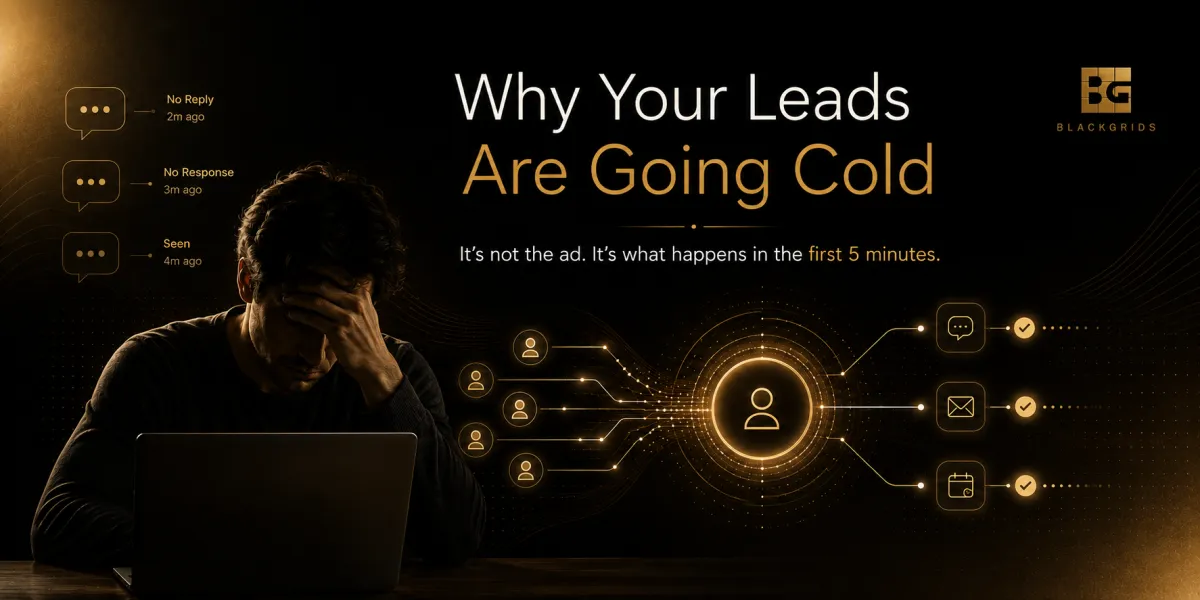
Why Your Leads Are Going Cold — And It's Not the Ad
The problem isn't your offer. It isn't your targeting. It's what happens in the first 5 minutes after a lead reaches out.
You've done everything right. The ad is running. The landing page is live. Leads are coming in. And then — nothing.
They don't answer the phone. They don't reply to the email. They don't book the call. By the time you follow up, they've already moved on.
So you do what most business owners do. You blame the ad. You change the creative. You adjust the targeting. You spend more. And the same thing happens again. The leads go cold.
Here's the part nobody tells you: the ad isn't the problem. The follow-up is.
This is not a marketing problem. It is a structural problem — one that affects businesses running Google Ads, Meta Ads, organic content, and referrals equally. And it has a specific, measurable, fixable cause.
The Real Reason Leads Go Cold
Leads don't go cold because your offer is weak or your ad is bad. They go cold because of time.
Not the time it takes them to decide. The time it takes you to respond.
Here's what the data from 2026 actually says:
78% of leads go to the first vendor who responds.
Source: Prestyj / Velocify 2026
After 10 minutes, the odds of contacting a lead drop by 400%.
Source: LeadAngel 2026
After 30 minutes, many prospects don't even remember which company they contacted.
Source: Apten Speed-to-Lead Report 2026
Read that last one again. Half an hour after filling your form, a prospect may not remember your name. Your follow-up call becomes an unknown number. Your email becomes noise in an inbox full of noise.
And the follow-up that most businesses send? It goes out 47 hours later on average. Not 47 minutes. 47 hours. By then, the lead isn't cold. It's gone.
"The entire game is won or lost in the first 5 minutes — which is exactly the window a human team staffing 9-to-5 cannot cover." — Sawy Speed-to-Lead Report 2026
The Response Time Decay Curve
Lead quality doesn't decline gradually after a form fill. It drops off a cliff. Here's what the 2026 data shows — and what it means for your pipeline:
The practical takeaway: there is no meaningful difference between responding in 4 hours and responding in 40 hours. The entire window that matters is the first five minutes. And the average business isn't anywhere near that.
Why Most Businesses Can't Win This Race — Manually
This isn't a motivation problem. Business owners know faster follow-up is better. The problem is structural.
Here's what a typical lead journey looks like for a business without an automated follow-up system:
Lead fills the form at 7:43pm on a Thursday — after business hours
Notification goes to an email inbox — that won't be checked until tomorrow morning
Team sees it at 9:15am Friday — 13.5 hours later
Someone calls — no answer (the lead is now at work)
Email sent — sits unread
Follow-up attempted Monday — the lead booked with a competitor on Friday afternoon
That's not negligence. That's a team doing their best inside a process that was never built to catch leads at the moment they're warmest.
According to Apten's 2026 report, over 40% of high-intent inquiries arrive during evenings and weekends. For home services businesses specifically, 41% of jobs are booked after hours. That means nearly half your pipeline is coming in when nobody on your team is working.
And in 2026, the problem is compounded further: Apple's AI call screening now intercepts calls from unknown numbers. If you didn't text the lead first while they still remember you, your follow-up call may never even ring through.
The Three Specific Moments Where Leads Go Cold
It doesn't happen all at once. There are three predictable drop-off points in every pipeline that hasn't been automated:
Drop-Off Point 1 — The First Response Gap
The most common and most damaging. A lead submits a form and hears nothing for hours. By the time the first message arrives, the lead's intent has decayed. They submitted to three other companies. One of them responded in four minutes. That one booked the call.
The fix: Automated SMS and email within 60 seconds of every form submission — regardless of when it comes in.
Drop-Off Point 2 — The Follow-Up Falloff
Most businesses follow up once, maybe twice. Research shows it takes an average of 8 touchpoints to convert a lead — yet most sales processes stop at one or two. After a non-response, the lead goes into a mental 'cold' category and nobody follows up again.
The fix: A structured multi-step sequence across SMS, email, and if relevant, voice — running automatically over 7, 14, and 30-day windows without anyone manually managing it.
Drop-Off Point 3 — The Weekend and After-Hours Gap
Your team goes home at 6pm. Your leads don't stop coming in. A lead that fills a form at 9pm Friday and doesn't hear back until 9am Monday has been waiting 60 hours. At that point, every competitor with an automated system has already had the conversation, booked the call, and potentially closed the deal.
The fix: A system that doesn't distinguish between 9am Tuesday and 11pm Saturday. The follow-up fires the same way regardless.
What Fixing This Actually Looks Like
The good news: this is not a complex problem to solve. It is a structural one. And structural problems have structural fixes.
Businesses that implement any form of automated first contact — SMS, email, or voice AI — reduce their average response time by 8x according to Prestyj's 2026 data. And businesses that move from a typical 24-hour response time to a sub-5-minute response time see conversion rate improvements exceeding 900%. Not a typo. 900%.
Here's what that looks like in practice:
Lead fills your form at 11:47pm — automated SMS fires within 60 seconds: personalised, relevant, from your business number
11:49pm — automated email follows with their specific service information and a direct booking link
Lead is tagged, scored, and segmented inside your CRM — no manual data entry, no missed information
Over the next 7 days — a structured follow-up sequence runs across SMS and email, adjusting based on what the lead opens, clicks, and responds to
When the lead clicks the booking link — the appointment goes directly into your calendar, confirmation fires automatically, and reminders are scheduled
Monday morning — you have three warm leads, two booked calls, and a pipeline report showing exactly where each one came from
This isn't a hypothetical. This is what a connected marketing automation system does for every lead that enters your pipeline — whether your team is working or not.
Why Ads Get the Blame When Follow-Up Is the Problem
There's a reason business owners default to blaming the ad when leads don't convert. The ad is visible. It has a budget attached to it. It has metrics — impressions, clicks, cost per lead. It feels controllable.
The follow-up process is invisible. It happens (or doesn't happen) in the background. There are no dashboards showing how many leads received a first response after 47 hours. There's no metric called 'deals lost to slow response.'
But the math is brutal. If you're spending ₹50,000 per month on ads and 63.5% of your leads never get a meaningful follow-up — according to Prestyj 2026 data — you are burning over ₹31,000 every month on leads you paid for and then abandoned.
The ad didn't fail. The pipeline failed the ad.
Fixing the follow-up doesn't require spending more on ads. It requires building the system that catches the leads the ads are already producing. That system — AI-powered, CRM-integrated, running 24/7 — is what turns ad spend from a gamble into a predictable pipeline.
Frequently Asked Questions
why do leads go cold after filling a form
Leads go cold after filling a form primarily because the response takes too long. Research consistently shows that after 5 minutes, the odds of successfully contacting a lead drop by 10x. After 30 minutes, many prospects don't even remember which company they enquired with. The lead hasn't lost interest in the service — they've simply moved on to whoever responded first. In most cases, that's a competitor with an automated follow-up system that fires within seconds of a form submission.
how fast should you follow up with a lead
The data is clear: within 5 minutes is the gold standard, and within 60 seconds is where the highest conversion rates are achieved. Leads contacted within the first minute convert at 391% higher rates than those contacted later, according to 2026 research from Prestyj and Velocify. For most human sales teams working standard hours, hitting this window consistently is impossible — which is exactly why automated follow-up systems exist.
what is the best way to stop leads going cold
The most effective way to stop leads going cold is to implement an automated follow-up system that responds within 60 seconds of every form fill — regardless of when it comes in. This means a combination of automated SMS (for instant acknowledgment), automated email (for context and next steps), and a structured multi-touch sequence that continues over 7–30 days. Connected to a CRM that tracks every interaction, this system ensures no lead falls through the cracks — whether it arrives at 2pm on a Tuesday or 10pm on a Sunday.
does response time really affect lead conversion that much
Yes — and the data is more dramatic than most business owners realise. Every 10-minute delay lowers conversion chances by 400%. Businesses that move from 24-hour response times to sub-5-minute response times see conversion rate improvements exceeding 900%. And 78% of leads go to the first vendor who responds — not the best one, not the cheapest one, not the most credible one. The first one. Speed is currently the highest-impact, most controllable variable in lead conversion.
what if my team can't respond to leads that fast
If your team can't consistently respond to leads within 5 minutes — especially outside business hours — the answer is automation, not more staff. An automated follow-up system built on GoHighLevel can respond to every lead within 60 seconds, run a qualification sequence, and book appointments into your calendar without any human involvement in the initial touchpoints. Your team only gets involved when a lead is warm, qualified, and ready for a real conversation. This is more efficient for the team and more effective for the pipeline.
The Fix Is a System, Not a Faster Team
If your leads are going cold, it is not because your team is slow or your ad is wrong. It is because you haven't built the infrastructure that catches leads at the moment they're warmest.
That infrastructure exists. It takes two to three weeks to build. And once it's live, it runs the same follow-up for every lead, every time — at 2pm on a Wednesday and at 11pm on a Saturday.
At Blackgrids, we build marketing automation systems that connect your lead capture to your CRM to your follow-up to your booking calendar — so the gap between 'lead came in' and 'call is booked' closes automatically, every time.
Get a Free Pipeline Audit
We'll show you exactly where your leads are falling off and what it would take to fix it. 20 minutes. No pitch. No pressure.
Click Here to get a free audit
Sources and External References
1. 78% of leads go to the first vendor who responds — Prestyj: AI Lead Response Statistics 2026
2. After 10 minutes, the odds of contacting a lead drop by 400% — LeadAngel: Speed to Lead Statistics 2026
3. After 30 minutes, many prospects do not remember which company they contacted — Apten: Speed to Lead Benchmarks 2026
4. Response time decay and the 5-minute rule — Sawy: Lead Response Time Statistics 2026
5. 391% higher conversion rates from 60-second response — LeadResponse: Speed to Lead Statistics 2026
6. 47-hour average B2B lead response time — Outsales: Lead Response Time Statistics 2026


