
Why Business Automation Should Be at the Centre of Your Expansion Strategy | Blackgrids
Here is what business expansion usually looks like without automation.
Revenue grows. Workload grows faster. The owner works longer hours. A few team members are hired. The workload grows again. More hours. More hires. Costs rise. Margins compress. The owner is busier than ever and the business is harder to run than it was when it was smaller.
That is not expansion. That is scaling chaos. And it is what happens when a business grows faster than the systems underneath it.
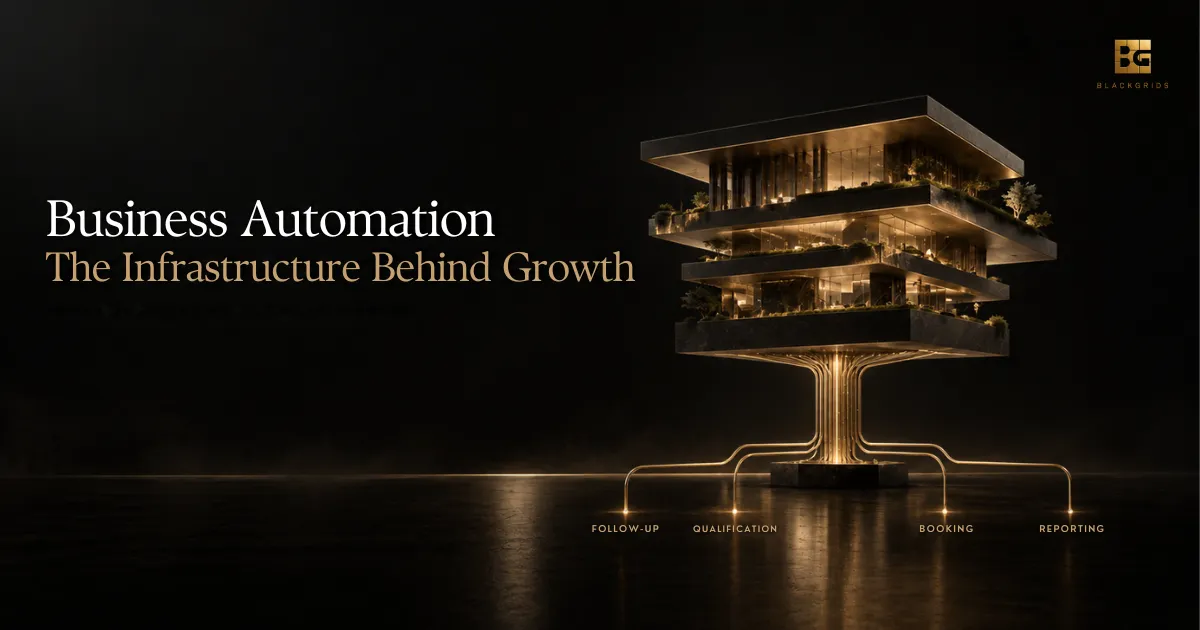
Business automation is the infrastructure that allows a business to grow without every unit of growth requiring a corresponding unit of human effort. It is the system that handles what should not require a person, so the people in the business can focus on what only a person can do.
This is not a concept reserved for large enterprises. In 2026, the most competitive businesses in every niche — med spas, real estate agencies, coaching businesses, contracting companies — are the ones that automated early and grew on top of that foundation.
The Scale Problem Every Growing Business Hits
Every business that grows eventually hits the same wall.
At ten leads a month, a person can follow up manually. At fifty leads a month, that same person is stretched. At two hundred leads a month, manual follow-up is impossible and deals are being lost not because the business lacks customers but because the process cannot keep up with the volume.
This is the scale problem. And business automation is the only solution that does not require proportional headcount growth to solve it.
240%
average ROI delivered by business process automation for service businesses
Source: LeadResponse: Business Automation Statistics 2026
40%
reduction in labour costs reported by businesses implementing automation tools
Source: Mean CEO: Business Automation Insights 2026
$19.6B
size of the business process automation market in 2026, up from $8B in 2020
Source: KissFlow: Business Process Automation Statistics 2026
What Business Automation Actually Does

The term gets used broadly. Here is what it specifically means for the kind of high-ticket service business Blackgrids works with:
It Removes Human Dependency from Repetitive Tasks
Every manual task in a business is a dependency. Someone has to remember to do it. Someone has to be available when it needs doing. Someone has to do it consistently, at the right time, every time. Automation removes that dependency entirely.
Follow-up that fires in 60 seconds regardless of the time. Qualification questions that run automatically the moment a lead responds. Appointment reminders that send themselves 24 hours and 1 hour before a call. Review requests that go out automatically after a completed appointment. Internal notifications that alert the right team member the moment a high-value lead enters the pipeline.
None of these require a person once the system is built. They run. Permanently.
It Creates Consistency at Scale
A human sales rep has good days and bad days. They follow up more thoroughly on leads they feel confident about. They miss leads that came in while they were in another meeting. They remember the process differently on a Tuesday than they do on a Friday.
Automation applies the same process to every lead, every time, without variation. The hundredth lead gets exactly the same follow-up sequence as the first. The lead that comes in at 11pm Saturday gets exactly the same response as the one that comes in at 10am Monday. Consistency at scale is impossible to achieve manually. It is the default when the system is automated.
It Turns Data Into Decisions
A properly built CRM and automation system tracks every interaction every lead has with your business. What they clicked. What they opened. How they responded. Which ad produced them. What stage of the pipeline they are in. How long they have been there.
That data — which is invisible in a manual process — becomes the dashboard that tells you exactly where your pipeline is leaking, which channels are producing revenue, and where the next optimisation should happen. Business decisions stop being guesses. They become conclusions supported by data.
Why Automation Is Essential Specifically for Business Expansion
Automation is useful at any stage of a business. But it is essential during expansion for a specific reason.
When a business expands, two things happen simultaneously. The volume of leads, clients, and transactions increases. And the complexity of managing everything increases even faster.
A business expanding without automation is manually managing more leads, more follow-ups, more appointments, more client communications, more team coordination, and more reporting — all at the same time. Something always falls through the cracks. Usually the thing that was most important.
A business expanding with automation absorbs the increased volume into a system that was designed to scale. The automation handles the volume. The team handles the relationships. The owner handles the strategy.
That is the only expansion model that does not require the owner to work proportionally more as the business grows proportionally larger.
93% of IT respondents saw measurable business growth linked to automation. 89% said their critical automated workflows now run smoothly across the organisation. — 2am.tech: Business Process Automation Statistics 2026
The Four Things That Must Be Automated Before You Scale
Not everything needs to be automated. But these four things must be automated before meaningful expansion is possible:
1. Lead Follow-Up
The first and most impactful automation in any service business. Businesses that follow up within 5 minutes are 9 times more likely to convert a lead than those who follow up after 30 minutes. At any meaningful scale, 5-minute manual follow-up is impossible. Automated follow-up makes it the default.
2. Lead Qualification
As lead volume grows, the time your team spends on unqualified leads grows with it. Only 25% of marketing-generated leads are immediately sales-ready — Forrester. AI qualification automatically sorts the 25% from the 75% so your team only engages with conversations worth having.
3. Appointment Booking and Reminders
Back-and-forth scheduling wastes hours per week that compound into days per month. Automated booking, confirmation, and reminders eliminate the manual coordination entirely and reduce no-show rates without anyone chasing leads to confirm attendance.
4. Reporting and Pipeline Visibility
Manual reporting is always delayed, always incomplete, and always retrospective. Automated dashboards show the pipeline in real time — lead sources, conversion rates, pipeline value, and team performance — so decisions can be made on current data rather than last month's spreadsheet.
What Happens to Businesses That Do Not Automate
The market in 2026 is not forgiving of manual processes.
The business process automation market is growing at 15.4% per year. By 2026, 30% of enterprises will have automated more than half of their operations — Gartner. The businesses automating now are the ones building competitive advantages that manual competitors cannot replicate without fundamentally changing how they operate.
When a competitor automates their follow-up and you have not, they get to every new lead faster than you can manually respond. When they automate their qualification and you have not, their team is spending time closing while yours is still sorting. When they automate their reporting and you have not, their decisions are based on this week's data while yours are based on last month's memory.
The gap compounds. Automation is not a productivity upgrade. It is a structural advantage that widens every month the competitor has it and you do not.
Frequently Asked Questions
why is business automation important for growth
Business automation is important for growth because it allows a business to handle increasing volume without proportional increases in headcount, cost, or owner involvement. Without automation, every unit of growth requires a corresponding unit of human effort. With automation, the system absorbs the growth and the team focuses on relationships and decisions rather than repetitive tasks. Business process automation delivers an average 240% ROI for service businesses and reduces labour costs by up to 40%.
what should I automate first in my business
The highest-impact first automation in any service business is lead follow-up. An automated response within 60 seconds of every form fill — SMS and email, personalised, from your business — immediately reduces lead loss and improves conversion rates. After that: lead qualification, appointment booking and reminders, and pipeline reporting. These four automations handle the highest-volume, most time-sensitive tasks that manual processes consistently fail at as volume grows.
is business automation only for large companies
No — and in 2026, small and medium businesses have more to gain from automation than enterprise companies. Large enterprises can afford large teams to handle manual processes. A small business with ten leads a week and two team members cannot. Automation levels the playing field — a small business with the right automation can deliver a faster, more consistent client experience than a larger competitor relying on manual processes. The tools are no longer expensive or complex. GoHighLevel, Make, and Zapier give small businesses access to enterprise-grade automation at a fraction of enterprise cost.
how does marketing automation support business expansion
Marketing automation supports business expansion by handling every stage of the lead journey automatically — from capture and follow-up through qualification, booking, and nurturing — so the sales team only engages with leads that are ready and the owner is freed from the operational detail of managing the pipeline. As the business grows, the automation scales with it without requiring additional headcount at each stage. The result is a business that grows its revenue without a proportional growth in cost, complexity, or owner involvement.
Sources
1. Business automation delivers 240% average ROI — LeadResponse: Business Automation Statistics 2026
2. 40% labour cost reduction from automation — Mean CEO: 33 Business Automation Insights 2026
3. Business process automation market size 2026 — KissFlow: Business Process Automation Statistics 2026
4. 93% of IT respondents see measurable growth from automation — 2am.tech: Business Process Automation Statistics 2026
5. 30% of enterprises automating more than half of operations by 2026 — Gartner via Quixy: Workflow Automation Statistics 2026


